
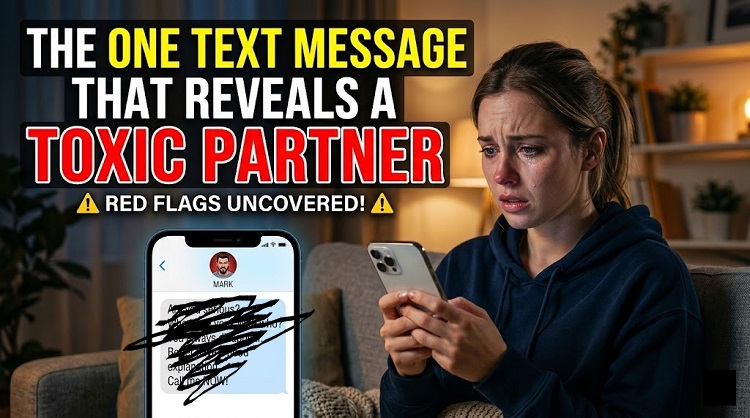
You probably expect toxic relationships to come with obvious warning signs.
Maybe constant yelling. Maybe cheating. Maybe someone who openly insults their partner in front of other people.
But in real life, toxic behavior often shows up in much quieter ways.
Sometimes it arrives as a simple text message.
Not a dramatic breakup text.
Not an angry paragraph written in all caps.
Just one sentence that seems normal at first glance.
A sentence that slowly makes you question yourself, feel guilty for things you didn't do, and apologize when you've done nothing wrong.
If you've ever felt stressed every time your phone lights up with a message from your boyfriend or girlfriend, there's a reason for that.
And surprisingly, one particular type of text message appears again and again in unhealthy relationships.
The Text Message That Should Make You Pause
Here it is:
"Wow. Fine. Do whatever you want."
Or some variation of it:
- "I don't care anymore."
- "Go ahead."
- "Whatever."
- "Clearly I'm not important."
- "Have fun without me."
At first, these messages don't seem dangerous.
In fact, many teenagers receive texts like this and assume it's just normal relationship drama.
The problem isn't the words themselves.
The problem is what's hiding underneath them.
These messages are often designed to create guilt instead of communication.
Rather than expressing feelings directly, the sender wants you to feel bad enough to change your behavior.
Instead of saying:
"I'm feeling left out because we haven't spent much time together."
They say:
"Whatever. Go hang out with your friends."
See the difference?
One message communicates.
The other manipulates.
Why This Text Works So Well
Toxic partners often avoid direct conversations because direct conversations create accountability.
Imagine this situation.
You tell your partner:
"Hey, I'm going to watch a movie with my friends tonight."
A healthy response might be:
"Sounds fun. Let me know how it goes."
Even if they're disappointed, they communicate honestly.
A toxic response might look like:
"Wow. Okay."
That's it.
Two words.
Yet suddenly your excitement disappears.
Now you're wondering:
- Are they angry?
- Did I do something wrong?
- Should I cancel my plans?
- Am I being selfish?
Notice what happened.
The conversation shifted from your normal plans to managing their emotions.
That's exactly why this tactic is so powerful.
The toxic partner never directly asks you to cancel.
They simply make you feel guilty enough that you choose to cancel yourself.
The Hidden Goal Behind Guilt Messages
Many people think toxic partners are always trying to control others intentionally.
Sometimes that's true.
But sometimes they aren't fully aware of what they're doing.
They've learned that guilt gets results.
If every time they send a passive-aggressive text you immediately apologize, cancel plans, or reassure them for an hour, the behavior gets reinforced.
Think about it like this.
Imagine someone discovers that pressing a button gives them exactly what they want.
They're probably going to keep pressing it.
For some toxic partners, guilt becomes that button.
And the scary part?
It often works incredibly well on caring people.
The kinder you are, the easier it becomes to manipulate you through guilt.
A Real-Life Example Many Teens Experience
Let's say Emma wants to attend a friend's birthday party.
She tells her boyfriend two days in advance.
His response:
"Cool."
Nothing seems wrong.
A few hours later, another text arrives.
"Don't worry about me."
Emma feels confused.
She replies:
"What do you mean?"
Then comes:
"It's obvious you'd rather be with them."
Now Emma spends the rest of the evening reassuring him.
The original topic—going to a birthday party—has completely disappeared.
The entire conversation becomes about his feelings.
Eventually Emma starts avoiding plans altogether because every invitation leads to emotional exhaustion.
This is how control develops.
Not through demands.
Through guilt.
Healthy People Say What They Feel
One of the biggest differences between healthy and toxic partners is emotional honesty.
Healthy people still get jealous.
They still feel insecure.
They still have bad days.
The difference is they communicate those feelings directly.
For example:
"I'm feeling a little left out."
"I was hoping we'd spend time together."
"I know it's irrational, but I'm feeling jealous."
These statements create room for discussion.
They don't blame.
They don't manipulate.
They simply express emotions.
A toxic guilt message, on the other hand, forces the other person to guess what's wrong.
And somehow the guess is never good enough.
The Problem With Constant Passive-Aggressive Texting
Everyone sends a passive-aggressive message once in a while.
Nobody communicates perfectly.
The red flag appears when it becomes a pattern.
If nearly every disagreement includes messages like:
- "Whatever."
- "Forget it."
- "Never mind."
- "You clearly don't care."
Then you're no longer dealing with occasional frustration.
You're dealing with a communication style.
And that style slowly damages relationships.
Why?
Because real issues never get solved.
Instead of discussing problems, both people end up trapped in endless cycles of guilt, reassurance, and resentment.
How Toxic Texts Change Your Behavior
One of the biggest warning signs isn't the text itself.
It's what the text makes you do.
Ask yourself:
Do you find yourself constantly explaining harmless decisions?
Do you feel nervous before telling your partner about plans?
Do you spend more time preventing arguments than enjoying the relationship?
Do you apologize even when you're unsure what you did wrong?
If the answer is yes, pay attention.
Toxic communication often trains people to become hyper-aware of another person's reactions.
You start editing your life to avoid conflict.
You stop doing things you enjoy.
You become smaller.
And relationships should never require that.
The Difference Between Hurt and Manipulation
Here's where things get tricky.
Sometimes people genuinely feel hurt.
Not every sad text is toxic.
For example:
"I'm kind of disappointed we won't get to hang out tonight."
That's honest.
That's vulnerable.
That's normal.
The person is sharing a feeling.
Compare it to:
"Clearly I'm the last thing you care about."
Now we're entering manipulation territory.
The first statement describes an emotion.
The second statement attacks, accuses, and creates guilt.
Learning to recognize this difference can save you from a lot of confusion.
Why Teenagers Often Miss This Red Flag
Teen relationships are usually full of intense emotions.
Everything feels bigger.
A delayed reply can feel like rejection.
A canceled plan can feel devastating.
Because of this, guilt-based behavior often gets mistaken for love.
Someone might say:
"They just care about me so much."
Or:
"They only get upset because they love me."
But love and control are not the same thing.
Love says:
"I trust you."
Control says:
"Make me feel secure by changing your behavior."
Love encourages independence.
Control punishes independence.
The two can sometimes look similar from a distance, which is why so many people miss the warning signs.
What To Do If You Receive This Kind of Message
First, don't immediately assume you're dealing with a terrible person.
People can learn unhealthy communication habits from family, friends, or previous relationships.
What matters is how they respond when the issue is addressed.
Try responding calmly.
For example:
"It sounds like something is bothering you. Can you tell me directly what's wrong?"
This shifts the conversation toward honesty.
A healthy person will usually explain their feelings.
A toxic person often doubles down.
They might say:
"Nothing's wrong."
Or:
"Forget it."
Or:
"It doesn't matter."
Even though their behavior clearly suggests otherwise.
That's an important clue.
Healthy communication moves toward clarity.
Toxic communication often moves away from it.
The Biggest Lesson Most People Learn Too Late
The most dangerous text messages aren't always the loudest ones.
Sometimes they're the quiet ones.
The short messages that leave you feeling guilty.
The messages that make you question your choices.
The messages that somehow turn your normal life into evidence that you're a bad partner.
A healthy relationship doesn't require constant emotional damage control.
You shouldn't feel anxious every time your phone vibrates.
You shouldn't need to decode hidden meanings in every conversation.
And you definitely shouldn't have to shrink your world just to keep someone else comfortable.
The next time you receive a text that says:
"Fine. Do whatever you want."
Look beyond the words.
Ask yourself a simple question:
Are they communicating their feelings?
Or are they trying to make me responsible for them?
That answer often reveals far more about a relationship than the text message itself.

