
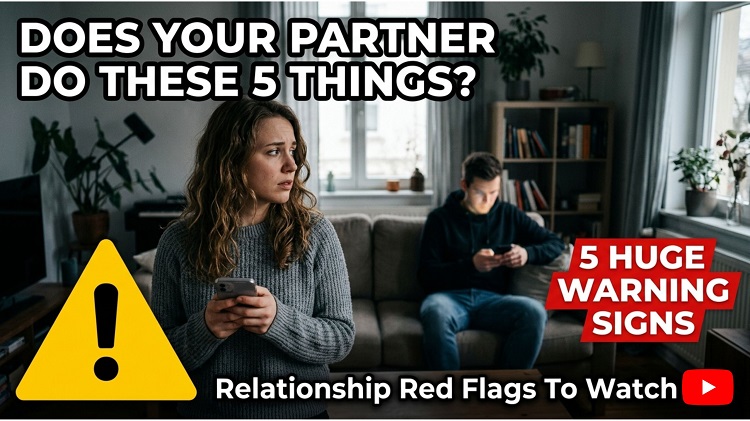
Nobody starts a relationship expecting it to become unhealthy.
Most people imagine relationships as a place where they feel safe, supported, and understood. But the truth is, not every relationship grows in that direction. Sometimes the warning signs are obvious. Other times, they're hidden behind sweet words, romantic gestures, or the excitement of being in love.
For teenagers especially, it can be difficult to tell the difference between normal relationship struggles and behaviors that signal something deeper. Movies, social media, and even friends can sometimes make toxic behaviors look romantic when they're actually serious red flags.
The tricky part is that unhealthy patterns rarely appear overnight. They often start small. A little jealousy here. A controlling comment there. A few hurtful jokes that seem harmless at first.
Then one day, you realize you're constantly stressed, second-guessing yourself, or feeling trapped.
If your partner regularly does any of the following five things, it may be time to take a closer look at the relationship.
1. They Try to Control Who You Talk To
At first, it can sound innocent.
"Why are you texting him so much?"
"I don't like that friend."
"You spend more time with them than with me."
Many teenagers mistake this behavior for love because it can feel like your partner cares deeply about you. But genuine care and control are two completely different things.
A healthy partner might express concerns occasionally, but they won't try to isolate you from friends, classmates, or family members.
Control often starts with subtle suggestions.
Maybe they constantly criticize your friends.
Maybe they get upset whenever you hang out without them.
Maybe they make you feel guilty for spending time with anyone else.
Over time, you might find yourself canceling plans, avoiding certain people, or constantly asking for permission before doing normal things.
That's not love.
A relationship should add to your life, not shrink your world.
One of the biggest warning signs is when you notice that your social circle has become smaller because your partner doesn't approve of the people around you.
2. They Make You Feel Bad About Yourself
Everyone says the wrong thing sometimes.
Even healthy couples occasionally hurt each other's feelings without meaning to.
The problem begins when criticism becomes a pattern.
Maybe your partner constantly jokes about your appearance.
Maybe they compare you to other people.
Maybe they point out your flaws every chance they get.
What's even more concerning is when those comments are disguised as honesty.
"I'm just telling the truth."
"You can't take a joke."
"I'm helping you improve."
Sound familiar?
A supportive partner should make you feel valued, not inadequate.
Imagine studying hard for a test and feeling proud of your score. Instead of celebrating with you, your partner immediately points out why it wasn't good enough.
Now imagine that happening with everything.
Your looks.
Your hobbies.
Your personality.
Your achievements.
Eventually, constant criticism can damage your confidence more than you realize.
Many people stay in relationships like this because they slowly begin to believe the negative things being said about them.
That's exactly why this red flag is so dangerous.
A good relationship shouldn't leave you questioning your worth every day.
3. They Never Take Responsibility for Their Actions
Have you ever argued with someone who somehow turns every problem into your fault?
No matter what happens, they always have an excuse.
They forgot your birthday? You didn't remind them.
They lied? You misunderstood.
They hurt your feelings? You're too sensitive.
This behavior can be incredibly frustrating because it makes solving problems almost impossible.
Healthy relationships require accountability.
Nobody is perfect. Everyone makes mistakes.
The difference is that emotionally mature people can admit when they're wrong.
A simple "I messed up, and I'm sorry" can go a long way.
But if your partner constantly avoids responsibility, the same problems will keep repeating.
You may even start questioning your own memory or judgment.
This is sometimes called "gaslighting," where someone manipulates situations in a way that makes you doubt your reality.
For example, imagine your partner sends a rude message. When you confront them, they claim it never happened—even though you clearly saw it.
Then they act as if you're the unreasonable one.
Experiencing this repeatedly can leave you feeling confused and emotionally exhausted.
A relationship can't grow if only one person is willing to acknowledge mistakes.
4. They Use Jealousy as a Weapon
A little jealousy is normal.
Most people feel insecure from time to time.
What matters is how those feelings are handled.
An unhealthy partner doesn't just experience jealousy—they use it.
Maybe they intentionally flirt with others to make you jealous.
Maybe they constantly accuse you of cheating without any evidence.
Maybe they monitor your social media activity like a detective.
Some even demand passwords, access to private conversations, or explanations for every interaction.
Here's the thing: trust is one of the foundations of any healthy relationship.
Without trust, every friendship becomes suspicious.
Every text message becomes a potential problem.
Every social activity turns into an argument.
Many teenagers mistake extreme jealousy for passion.
They think:
"They're jealous because they love me."
In reality, excessive jealousy often comes from insecurity, possessiveness, or a desire for control.
Love should feel secure.
You shouldn't have to prove your loyalty every single day.
One useful question to ask yourself is this:
Do you feel trusted by your partner?
Or do you feel like you're constantly being investigated?
The answer can reveal a lot about the health of the relationship.
5. They Ignore Your Boundaries
This might be the biggest warning sign on the list.
Boundaries are simply the limits that help people feel comfortable and respected.
Everyone has them.
Some people need personal space.
Some people aren't comfortable sharing passwords.
Some people aren't ready for certain levels of physical intimacy.
Healthy partners respect those boundaries.
Unhealthy partners push against them.
They pressure.
They guilt-trip.
They keep asking after you've already said no.
For example, imagine telling your partner you're uncomfortable posting relationship photos online.
Instead of respecting your decision, they repeatedly pressure you until you give in.
Or maybe you say you're not ready for something physically or emotionally, and they respond with:
"If you really loved me, you would."
That sentence alone has damaged countless relationships.
Real love respects consent.
Real love respects comfort levels.
Real love doesn't try to wear someone down until they agree.
One of the clearest signs of respect is how someone responds when they hear the word "no."
A caring partner listens.
A manipulative partner treats it like a challenge.
Why These Warning Signs Are Often Ignored
One reason people stay in unhealthy relationships is because red flags rarely arrive all at once.
If someone showed every toxic behavior on the first date, most people would walk away immediately.
Instead, unhealthy patterns usually appear gradually.
The relationship may start out amazing.
There may be genuine affection and good memories.
That's what makes things confusing.
People often focus on the good moments and hope the bad moments will disappear.
Sometimes friends and family notice the warning signs before the person in the relationship does.
If multiple trusted people express concern, it may be worth listening instead of dismissing their observations.
Outside perspectives can sometimes reveal patterns that are difficult to see from the inside.
What You Should Do If You Notice These Behaviors
First, don't panic.
Seeing one of these behaviors doesn't automatically mean the relationship is doomed.
People can learn, grow, and change—if they're willing to acknowledge the problem.
Start by paying attention to patterns rather than isolated incidents.
Ask yourself:
- Do these behaviors happen regularly?
- Have I communicated my concerns?
- Does my partner listen when I bring up problems?
- Do I feel respected, safe, and valued?
Your answers can provide important clarity.
It can also help to talk with someone you trust.
A friend, sibling, parent, teacher, counselor, or mentor may offer an outside perspective that's easier to see than your own.
Most importantly, trust your feelings.
If you're constantly anxious, drained, controlled, or unhappy, those emotions are trying to tell you something.
You don't need a dramatic reason to leave a relationship that isn't healthy for you.
Final Thoughts
The healthiest relationships don't make you feel trapped, insecure, or afraid of making mistakes.
They make you feel supported.
They encourage your growth.
They respect your boundaries.
And they allow you to be yourself without constantly worrying about judgment or control.
Nobody gets everything right all the time. Relationships require patience, communication, and effort from both people.
But when controlling behavior, constant criticism, manipulation, extreme jealousy, or boundary violations become a pattern, it's worth paying attention.
Sometimes the biggest red flag isn't a single action.
It's how often that action happens—and how it makes you feel every time it does.

